Friday, April 17, 2009

Nokia E71

- Nokia E71x for AT&T
General
2G Network
GSM 850 / 900 / 1800 / 1900
3G Network
HSDPA 900 / 2100

HSDPA 850 / 1900 - American version
Announced
2008, June
Status
Available. Released 2008, July
Size
Dimensions
114 x 57 x 10 mm, 66 cc
Weight
127 g
Display
Type
TFT, 16M colors
Size
320 x 240 pixels, 2.36 inches

- Full QWERTY keyboard- Five-way scroll key
Sound
Alert types
Vibration; Downloadable polyphonic, monophonic, MP3 ringtones
Speakerphone
Yes

- 2.5 mm audio jack
Memory
Phonebook
Practically unlimited entries and fields, Photocall
Call records
Detailed, max 30 days
Internal
110 MB storage, 128 MB RAM
Card slot
microSD (TransFlash), up to 8GB, hotswap, buy memory
Data
GPRS
Class 32, 100 kbps
HSCSD
Yes
EDGE
Class 32, 296 kbps
3G
HSDPA, 3.6 Mbps
WLAN
Wi-Fi 802.11 b/g
Bluetooth
Yes, v2.0 with A2DP
Infrared port
Yes
USB
Yes, v2.0 microUSB
Camera
Primary
3.15 MP, 2048x1536 pixels, autofocus, LED flash
Video
Yes, QVGA@15fps
Secondary
Videocall camera
Features
OS
Symbian OS 9.2, Series 60 v3.1 UI
CPU
ARM 11 369 MHz processor
Messaging
SMS, MMS, Email, Instant Messaging
Browser
WAP 2.0/xHTML, HTML
Radio
FM radio; Visual radio
Games
Java downloadable
Colors
White Steel, Grey Steel, Black, Red
GPS
Yes, with A-GPS support; Nokia Maps
Java
Yes, MIDP 2.0

- MP3/AAC/MPEG4 player- Document viewer (Word, Excel, PowerPoint, PDF)- Push to talk- Voice command/dial- Organizer- Printing
Battery

Standard battery, Li-Po 1500 mAh (BP-4L)
Stand-by
Up to 410 h (2G) / 480 h (3G)
Talk time
Up to 10 h 30 min (2G) / 4 h 30 min (3G)
Music play
Up to 18 h

T-Mobile Sidekick LX gets a new upgraded 2009 version


T-Mobile announced an upgrade of their Sidekick LX from 2007 - it's called... well, Sidekick LX. The 2009 edition has a beefier display, 3G connectivity, GPS chip, 3.2 megapixel camera and updated OS.
The renewed T-Mobile SiDEsports a 3.2-inch WVGA display, a 3.2 megapixel camera with auto-focus and LED flash, microSD expansion slot (1GB card in the box), 3G support and built-in GPS receiver. The handset will also be noticeably thinner than its hefty predecessor, but follows the same design - though now it's also got a bigger battery.
The Sidekick LX has an updated Danger OS, which is now tightly integrated with all popular social networks such as Facebook, MySpace, Twitter and Photobucket.
The Sidekick LX 2009 is expected to hit the shelves on 13 May in T-Mobile USA network as far as we know. The new handset will be priced at 200 US dollars (150 euro) on a contract basis
SOURCE : www.gsmarena.com

Thursday, April 16, 2009

Tuesday, April 14, 2009

Nokia N73


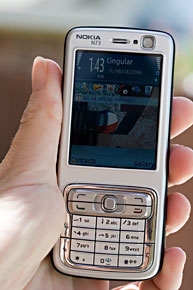
You know something is up when you receive a powerful smartphone and you don't rip open the box to make a phone call or try out an Excel spreadsheet. Instead you slide open the camera lens cover and madly take photos of anything remotely attractive or interesting. That's the Nokia N73: a camera that just happens to have a smartphone attached. If great photos aren't your thing, Nokia offers a wide variety of Symbian OS S60 phones with lesser cameras and other strong points such as the Nokia E61's QWERTY keyboard and the Nokia N91's 4 gig hard drive for MP3s aplenty. If quality photos are important, the N73 and its bulkier sibling the N93 (which lacks the 850MHz band used by Cingular in the US) are Nokia's top offerings. The Nokia N80 has a 3MP camera that's quite good (once you adjust to the shutter lag), and you'd likely be pretty impressed if you saw the photos it takes. That is, until you see the N73's photos. The N73 has a 3.2 megapixel camera and adds a Carl


The Nokia N73 is a quad band GSM world phone which will work anywhere GSM service is available. It has EDGE and UMTS 3G on the 2100MHz band (for Europe, not the US), Bluetooth 2.0 + EDR, 240 x 320 QVGA display, miniSD card slot, full PIM applications with easy syncing to Outlook (and the Mac with little trouble), MS Office document viewers, MP3 player, FM radio, stereo output, email client and a full HTML web browser.


source : http://www.mobiletechreview.com

Thursday, April 9, 2009

TDG-9920

  • Handset
  • Charger
  • Manual
  • Headset
  • Disk with software
  • Cable for synchronization with PC (СОМ)

A customary user of the majority of European countries knows at least 7-8 mobile phone manufacturers and others arouse his suspect. Asian manufacturers are treated this way the most, besides the companies are not widely known they may be associated with low-quality products by the country of origin only. And a manufacturer's announcement that his phone is the smallest, loudest and the best is one of the factors putting a user on his guide. If such an announcement is the one that makes you think the product is of a middling quality, but if the whole package box is abounding with such descriptions in a superlative form the product makes no any wish to have a look at. By the way many phones didn't reach us just because of it. One look at their package was enough to refuse from committing a test. In a TDG-9920's case first we received the specifications and only then the model itself. We are grateful to the manufacturer for the efficient delivery of the test example.

The package box looks like mage following the guide "How one shouldn't make a package box". If such a manual really existed the designers of this box probably would be the authors. First, a note telling the device belongs to a new generation and is the smallest one with a camera is placed on the front side. The folding part tells about some unique functions like:

  • Worlds First Ultrasonic Mosquito Repellant function for GPRS
  • Worlds First Acupressure Reader function for GPRS
  • Bio-Rhythm Reader function
  • Worlds First Phone to have Flashlight function

The first two functions have nothing in touch with batch communication and why the word GPRS appeared here is not clear. Just following some logics it either has to be in the whole three items or in none of them. The fourth announcement is not true, there are many phones equipped with a flash function and it appeared far longer ago than yesterday or a day before. Similar faults are easy to find on a box and that doesn't make the device look better in our eyes. As for me, the manufacturer should reconsider the notes on the box for a European user and take all the superlative degrees away as soon as possible. Having got upset because of the box I expected some dirty tricks from the device itself. Integrated functions announced by the manufacturer frightened the most, what is a Mosquito Repellant for in the phone? They'd better integrate a coffee-machine. Phones are rich in functions today and some of them are too exotic just scaring a user away but not attracting. How do ordinary customers think? They think if something is added to a phone it's charged for extra. And who is ready to pay more for a not very necessary function? The answer is plain - only some individuals. Wishing to attract a customer the manufacturer get just the opposite effect scaring them away (not mosquitoes but people).

A standard componentry is the first positive factor. A cable for synchronization (COM not USB that is not very attracting) and a disk with software may be found in a package besides the phone, the manual and the headset.

The phone is really not large and looks like an accurate bar with round corners. The design resembles the devices by Maxon in some kind that were manufactured in the same form-factor and similar color solutions. But everything is not the same here. Thus a sliding panel protecting the VGA-camera may be seen on a front panel. An external screen is absent because there is too little space for it on this small device. There is a service indicator having 7 different backlighting colors on the external panel. A flash lamp is from the side (works like impact and is a point light source really). Loudspeakers are hidden by the slits on both sides, they provide a volumetrical sound in the phone. That's curious that a NEC chipset is used, usually it's integrated into devices of a higher class.

The manufacturer offers several body colors, they are silvery, pearly red and pearly black. The two last colors go with a glossy surface and a body colors around an external shutter is different in all the cases. As for me, a silvery solution looks customary and two other colors are of interest and make the phone more fashionable in some kind.

The dimensions are 71x39x26 mm and the weight is 95 grams. The size is not big but the thickness is comparatively big. Holding the phone is comfortably even having big hands. The device is noticeable in a pocket of a shirt and it's its thickness that plays any role here but not width or height. In all the rest the device is quite comfortable and carrying it is possible just as you like, no any problems appear. The external shutter is easy to move and open but almost doesn't slide accidentally.


Source : http://www.mobile-review.com

LG KG800 Chocolate

  • Handset;
  • Charger;
  • User’s guide;
  • CD with software for phonebook synchronization, connectivity applications and various content;
  • USB-wire;
  • Travel charger;
  • Carrying bag;
  • Earphones;
  • A remote control with 3.5 mm jack for operating the media player and the microphone;
  • Two protective films for the front panel;
  • Bluetooth-headset (optionally);
  • A trinket with foam-rubber for cleaning the phone, on the other side.

Over the very recent times, LG Electronics has been practicing the policy when potential have no idea of index of an upcoming model, but its affiliation with Black Label series. And the first model coming from Black Label line-up to appear on the European (May, 3rd) and CIS markets (May, 8th and 12th) was a slider. The handset stands out for its fancy design with touch keypad and feature pack.

Before launching the Chocolate Phone into Europe, the manufacturer had been testing it out in Korea, where it turned out to be an overwhelming success – during the first three months more than 300 thousands of these handsets were sold countrywide. To make the scale of its popularity clear, let us turn to the figures and simply say: that amount makes nearly 7% of the entire Korean market. Thus, stirred up with that, the company took the decision to widen audience coverage and expand Black Label’s boundaries from the home market only to the US, Australia and Europe.

Having read or caught a glimpse of available information on the Chocolate product line, you are likely to have no luck with picking out technical specifications – as a matter of fact, phrases like Black Label series, Chocolate and Magic touch are everything you’re going to find.

Black Label – a series of handsets coming in black with glossy, mirror-like finishing, featuring only safe materials and lead-free solder.

Chocolate Phones – phones, appearance-wise reminding of a bar of black chocolate.

Magic Touch – a commercial title of the technology applied to handsets with finger-tip control. The controls themselves are covered with compounds of silver.

Integrating, these mysterious titles attract everyone’s attention. The Chocolate Phone, which is the main subject of this review, is really an eye-grabbing thing, making people wonder whether it is a phone in your hands, and if yes, why it lacks buttons? But once the spring mechanism has revealed the controls, the initial astonishment turns into stupor. And it normal, firstly because this is a handset after all, but the numeric keys are laid out as if it was a chess-board; but secondly! Once unsprung, the flat, glossy becomes an easily distinguishable cell phone, as the controls mounted on the top half get lit up with red.

The efforts of the designers will be estimated at their true worth by anyone, who only grasps this handset. Basically, neither iF Design Award nor Red dot Design Award jury could withstand it, so the Chocolate’s box shows off two medals awarded by these associations.

Nevertheless, it’s time to put the dithyrambs aside and see what caused such sensation and why LG pays so much attention to this series.

The enormously rich standard kit is packed up in an appealing black box, which appears to be made of cloth at the first glance.

When getting a grip on the handset, the very first thing grabbing your eyes is a silver rectangle with rounded corners, since it is the only prominent thing on the front; the top rim, right above the display holds a horizontal opening with black loudspeaker’s grill placed into it.


The handset is switched on by pressing the key found on the right side. In fact this is the first time LG uses a special power button. The phone can be turned on when closed; yet in order to prevent accidental shutting offs in pockets, the developers made it possible to switch the device off only when it is open.


This is the way the phone starts up: at first the greeting screen shows WOWLG portal ad, afterwards the dark-red backlighting gets activated – overall it takes 30 seconds for the handset to become fully operational. Next to the power button you will find a dedicated button standing for Multimedia menu (MP3, camera). Newly developed interface connector, sealed up with a plastic stub, is positioned on the top – it is compatible with USB-cable, charger and stereo-handset. The company has knowingly left out all other jacks, since it does not overcrowd the casing and allows using the released space in a better way in the first place, and on top of that one won’t need to memorize which jack means what. And finally, all future models located in the price brackets from middle to the most luxurious will be carrying exactly this interface, so that all accessories will be interchangeable – be it chargers or headphones.

The opposite side houses another rocker key for locking the phone by double pressing. Apart from this it doubles as scroller, volume key in standby mode (tunes volume) or during a call (voice volume).

The other sides lack any controls or jacks, in light of using the brand new interface connector.

Having looked on the rear you will find it being absolutely flat with only exception of battery cover, which is well-tuned and exposes no gap.

Pushing the top half forward, you will notice that the phone smoothly slides up to the stop with an audible click – the same sound you will hear when closing the phone. On opening the keypad and controls get lit in red, matching the wallpapers, which feature the same black-red color combination.


Source : http://www.mobile-review.com

Fly MX200

  • Handset;
  • Battery;
  • USB-cable;
  • Wired stereo headset;
  • Charger;
  • Software CD;
  • User Manual.

Fly is expanding its line-up with many new products. It’s interesting to see that most products are not similar to each other, all have their own peculiarities. Today we shall speak about Fly MX200, slim clamshell phone with two displays, built-in VGA camera, mp3 player, support of memory cards (T-Flash) and IrDA. As you can see, this model is quite functional, which has been rare for this manufacturer until recently. But time goes, and everything changes, and in order not to lag behind their competitors, companies have to improve their models.

Handset does not seem small if you look at it, although its size is typical for today’s phones – 44x90x17mm, weight – 73.4 grams. Model fits your hand nicely, due to small thickness it can fit shirt’s pocket easily, and this is just what we need with Summer approaching. Design does not offer anything new – rectangle case shape with slightly smoothened edges, but despite this, phone still looks interesting. There are two colors in which this phone will be available, it’s possible to say that one is for “boys” and other for “girls”: completely black case, and mix of pink with silver. Both editions look interesting, in case with black color, it can be obtained by both male and female users, meanwhile pink will most likely stay female only type. It’s kind of hard to imagine a man using pink phone, even though I had to do it myself, but that’s my job and what I have to deal with. Survey of female consumers shown that most of them would go for Pink color. And after we asked “why?” – response was as follows “it looks cuter in Pink”.